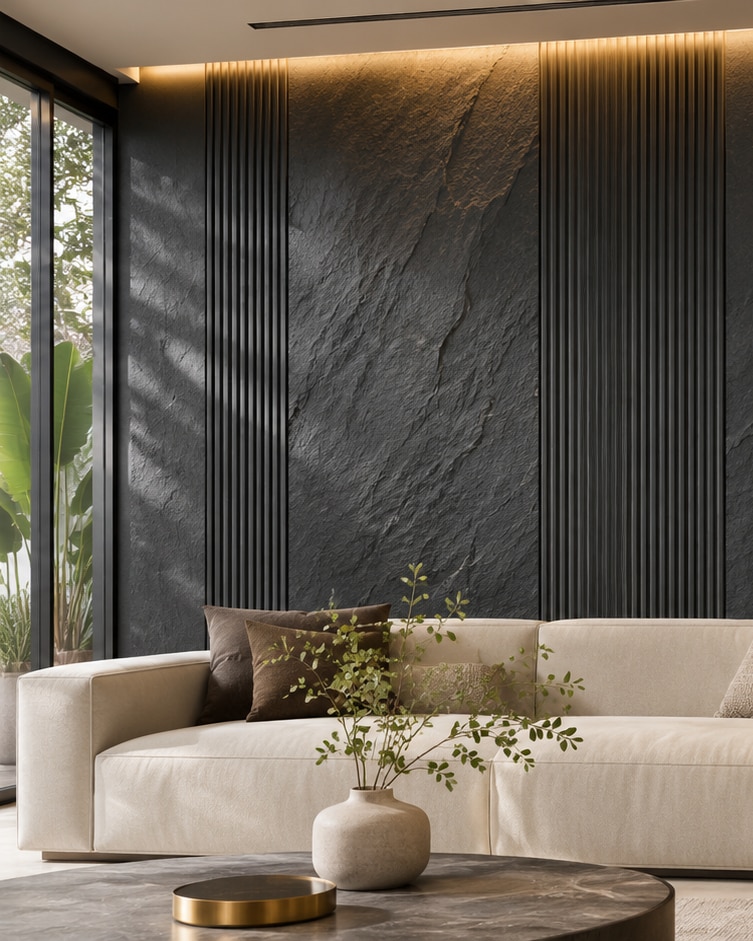
A dark wall panel can look expensive while failing on moisture resistance, fire performance, alignment, or repairability. By the end, you will be able to identify what the panel is made from, choose a suitable design and location, calculate quantities, prepare the wall, and compare it with other decorative finishes using evidence rather than the word “charcoal.”
Key takeaways
- Confirm the substrate, backing, joints, moisture rating, and fire performance before ordering.
- Choose panels for humidity, sunlight, cleaning, and acoustic needs—not colour alone.
- Measure openings, corners, wall irregularities, and spare panels before installation.
- Use a level, planned joint layout, and accessible fixings for future repairs.
What a Charcoal Panel Actually Is—and How It Differs from Moulding
A charcoal wall panel is not defined by its colour. “Charcoal” can mean a charcoal-coloured finish, carbonised wood, or a dark acoustic product made from PET felt, MDF, veneer, mineral fibre, WPC, PVC, or another substrate. The substrate, face coating, backing, and joints determine moisture resistance, durability, acoustic behaviour, and fire performance.
- Request the exact core material, face finish, total thickness, backing, edge treatment, and panel dimensions. “Low VOC” alone does not identify a compliant composite-wood product; ask for TSCA Title VI documentation where applicable.
- Confirm whether the face is natural veneer, printed film, paint, laminate, fabric, or a charcoal-based material. Each reacts differently to sunlight, moisture, cleaning, and batch variation.
- Obtain fire-test evidence for the complete installed system. ASTM E84 results do not automatically cover a changed adhesive, backing, joint, thickness, or decorative face; NFPA 286 may apply to the assembly or occupancy.
- Treat acoustic claims narrowly: a felt or slatted absorber reduces reflected sound, but it does not provide sound isolation through a wall.
| Product | Construction | What to verify |
|---|---|---|
| Charcoal panel | Broad finished board fixed across a wall | Core, backing, joints, and tested assembly |
| Charcoal moulding | Narrow profiled trim or strip | Width, depth, profile, and fixing method |
A charcoal moulding is not evidence of charcoal panels. Confirm the supplier is offering wall-covering boards rather than decorative trim.
Choose the Look Around the Room’s Conditions, Not Just Its Colour
A full-height wall needs panel dimensions that relate to the room’s scale: broad panels calm a large elevation, while narrower modules suit a column, bedside wall, or short entryway. Choose thickness for the wall’s condition and fixing method, not appearance alone; a heavy panel on dusty plaster needs more than adhesive.
Use the room’s light and traffic to select the detail.
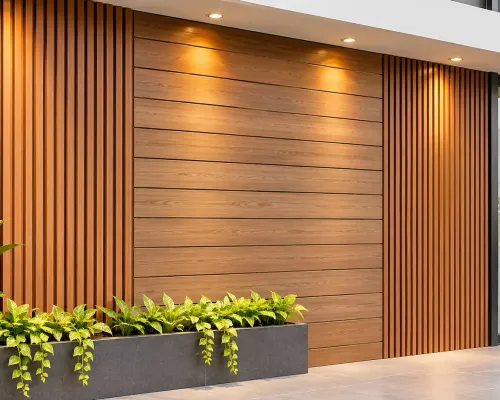
- Choose deep fluted panels when grazing light should create shadow and vertical emphasis; shallow profiles look quieter and collect less dust.
- Match grain direction to the architecture. Vertical grain lifts a low ceiling, while horizontal grain can widen a narrow wall.
- Approve a physical sample in daylight and artificial light. Dark wall panels reveal scratches, joins, and batch differences more readily than pale finishes.
- Record the approved batch or lot and order enough for one continuous elevation. Replacement panels can differ in charcoal tone, veneer grain, or textured coating.
- Use a matte or low-sheen finish where windows or spotlights create glare; reserve higher sheen for low-touch feature areas.
- Keep textured or absorbent surfaces away from splash zones unless the manufacturer gives a cleaning and moisture rating.
| Option | Best room location | Main design effect |
|---|---|---|
| Full-height, broad modules | Living-room or lobby feature wall | Fewer joints and a calmer luxury wall decoration |
| Narrow, deep profile | Bedroom, dining niche, or column | Strong shadow rhythm and vertical height |
| Acoustic felt or slat construction | Media room or office | Reduces reflected sound, but does not isolate rooms |
| Smooth dark finish | Low-touch formal wall | Rich colour with easier visual coordination |
For luxury interior design, place the strongest grain or colour variation where furniture will not hide it. Use lighter panels in dim rooms; dark finishes can make a small room feel enclosed.
Plan Quantities, Openings, Corners, and the Existing Wall Before Ordering
Measure every wall as a separate elevation: record its width, height, corners, columns, doors, windows, skirting, and ceiling junctions. Do not rely on floor area alone; panel quantity calculation must account for the panel’s usable face width and the direction of its profile or grain.
- Check the existing wall with a 2-metre straightedge, spirit level, and tape measure. Remove loose paint, grease, damp material, and projecting fasteners. Fill holes, repair cracks, and correct high or hollow areas before ordering; dark repeating panels expose small alignment errors.
- Draw each elevation to scale and mark every opening. Measure door and window widths, heights, architraves, switch plates, electrical outlets, sprinkler heads, waste pipes, and other penetrations from the nearest corner and from the floor.
- Calculate panels by rows and columns, then add cutting waste. Allow more waste when panels must wrap columns, align across doors, or match a directional pattern; keep spare pieces from the same batch for later repairs.
- Decide how the panels finish at skirting, the ceiling, and outside corners. Confirm whether panels stop above the skirting, replace it, meet a shadow gap, or use a trim. Measure every face of a column separately rather than treating it as flat wall.
- Mark the finished panel thickness on outlet and switch locations. Arrange for electrical boxes, covers, and door trims to project correctly after installation; never force a panel over a cover or leave an unsupported cut edge.
Approve a measured drawing and cut plan before ordering. That prevents a beautiful surface from failing at its first socket or corner.
Install Charcoal Panels for Alignment, Movement, and Future Repair
Adhesive fixing suits a light panel on a clean, dry, sound wall, but it is a poor default for heavy boards, dusty paint, uncertain moisture, or planned removal. Specify panel installation against a flat substrate, a measured reveal, an aligned datum, edge treatment, and trims around outlets, doors, corners, and sprinklers.
Leave the manufacturer’s perimeter clearance for movement.
| Method | Best use | Main risk |
|---|---|---|
| Adhesive fixing | Light panels on prepared walls | Difficult removal; adhesive can tear paint or substrate |
| Mechanical fixing | Heavy panels or serviceable installations | Visible heads unless screws, cleats, or caps are concealed |
| Battens or hybrid fixing | Uneven walls, cable routes, or replaceable sections | Changes wall depth and acoustic behaviour |
Plan spare panels from the same production batch, photograph concealed fixings, and keep an access route for damaged sections. A batten cavity can alter absorption, while a rigid adhesive bond can reduce decoupling; use the manufacturer’s tested acoustic build-up rather than assuming the panel rating transfers to your wall.
For fire safety, demand the test report for the complete assembly: panel thickness, backing, joints, adhesive or mechanical fixing, and substrate. A raw board’s Class A or flame-spread claim does not automatically cover a laminate, fabric, acoustic backing, or site-built system.
Compare Charcoal Panels with Other Luxury Wall Finishes Before You Commit
Charcoal panels suit a feature wall where texture, durability, and reduced reflected sound matter more than the lowest cost or easiest repaint. They do not isolate a room: acoustic panels absorb some reverberation, while sound isolation still depends on the wall assembly, airtightness, mass, and penetrations.
| Finish | Charcoal panels are better when | Choose the alternative when |
|---|---|---|
| Wallpaper | You need a tactile, impact-resistant focal wall | You want the widest pattern range, quick changes, or a lower-cost finish |
| Paint | You need texture and concealed minor wall marks | You need easy touch-ups, colour changes, or continuous coverage around awkward openings |
| Decorative glass film | You want warmth and a non-reflective surface | You need privacy on glass, cleanability, or a light-transmitting partition finish |
| Wood flooring | You want a coordinated wood look on a wall | You need genuine flooring durability under foot traffic; wall-mounted flooring adds weight and installation work |
| WPC louvers | You want a softer, more residential texture with acoustic backing | You need moisture tolerance, easy washing, or a stronger linear architectural effect |
| Conventional wall panelling | You want a lighter decorative system with sound absorption | You need heavier impact resistance, deep mouldings, or a formal built-in appearance |
The wallpaper versus wall panels decision also includes repair: wallpaper can be replaced by roll, while a damaged panel may require a matching batch. Record the approved lot because dark finishes can vary.
In a paint comparison, confirm fire classification rather than assuming a charcoal colour is fire-resistant. Ask Dels Decor whether a quoted item is moulding or a complete panel before comparing coverage, joints, and replacement requirements.
Related product
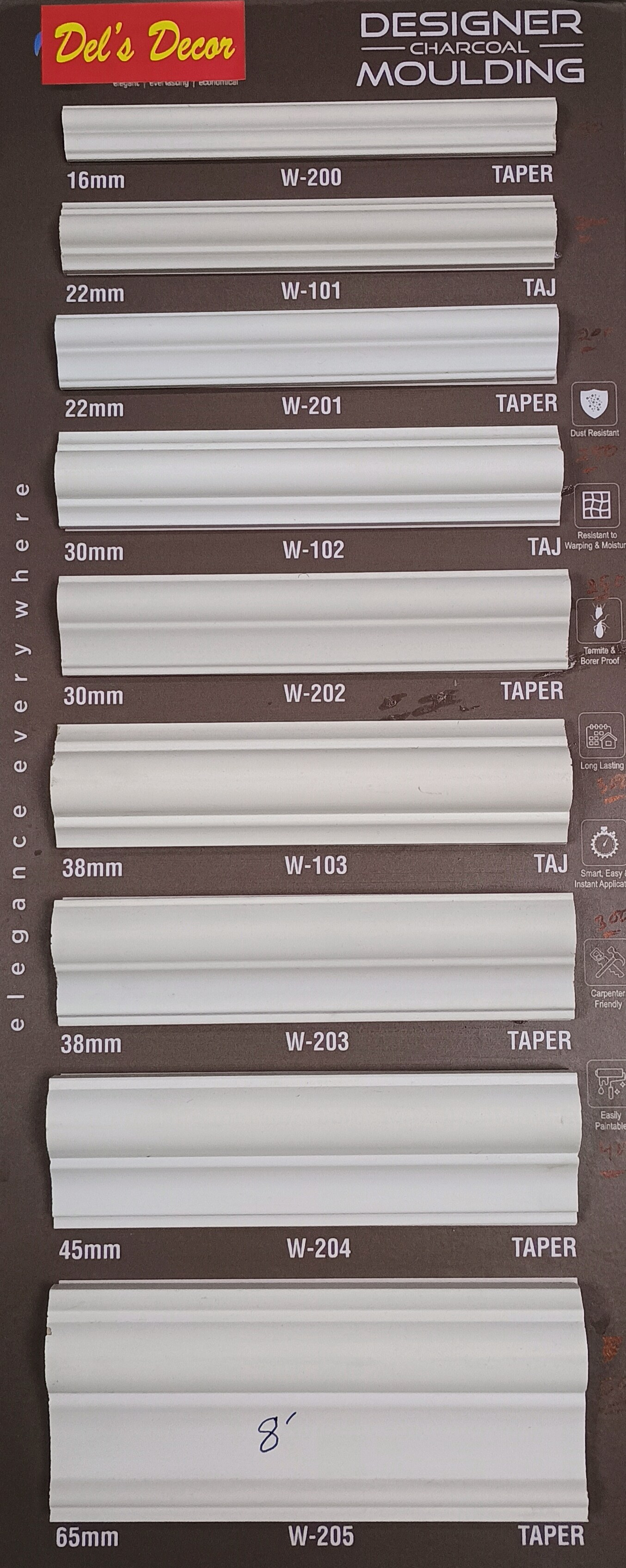 | Accessories ₹150 Material: Charcoal Color: White Finishing: PO Coated Usage/Application: Commercial, Residence, Office, etc View product → |
Frequently asked questions
What is a charcoal wall panel?
It is a wall panel with a charcoal-coloured or carbonised finish, made from substrates such as PET felt, MDF, veneer, mineral fibre, WPC, or PVC. Its substrate, coating, backing, and joints determine performance.
How should you choose charcoal panels for a room?
Assess moisture, sunlight, cleaning demands, acoustic needs, and fire-performance requirements before choosing the colour or surface finish.
What should you measure before ordering charcoal panels?
Measure wall lengths and heights, then deduct doors, windows, and other openings. Record corners, outlets, uneven areas, and add material for cuts and future repairs.
How do you install charcoal wall panels correctly?
Set out the joint lines, check the wall, use suitable fixings or adhesive, allow for movement where required, and keep spare panels for later repairs.
What alternatives should you compare with charcoal wall panels?
Compare them with moulding, paint, wallpaper, wood veneer, stone, textured plaster, and acoustic treatments for cost, maintenance, moisture resistance, appearance, and repairability.
Keywords