A custom wallcovering succeeds when the artwork, material, measurements, lighting and installation method are planned as one system. By the end, you will know how to brief a supplier, choose a format for each room, prepare the walls and avoid costly mistakes in residential or commercial interiors.
Key takeaways
- Request a scaled proof showing colours, crop, panel breaks and pattern alignment.
- Measure finished wall height and width, including doors, windows and obstructions.
- Prepare the wall before installation; uneven surfaces show through wallpaper.
- Match the finish and pattern scale to lighting, furniture and viewing distance.
From room brief to finished wallpaper panels
The custom wallpaper design process starts with a room brief: the wall to cover, its finished height and width, viewing distance, lighting, furniture position and preferred mood. Supply your own artwork or choose a designer’s concept, then request a scaled proof showing colours, crop, panel breaks and pattern alignment.
| Option | What it means | When it applies |
|---|---|---|
| Made-to-measure wallpaper | Printed or cut to the specified wall dimensions | When standard roll widths would create awkward joins or excess waste |
| Digitally printed wallpaper | Artwork printed directly onto the selected wallpaper substrate | When you need a photograph, illustration, logo or bespoke colour palette |
| Mural panels and repeated rolls | A mural arrives as numbered image sections; repeated rolls carry a recurring pattern | Choose panels for one continuous scene and rolls for an all-over design |
- Confirm the final wall measurements, substrate, panel number, sequence, scale and colour proof before cutting. A missing or damaged panel reordered later may differ in colour or revision.
- Calculate pattern-match waste, including extra length at the ceiling and floor. Large repeats and drop matches need more material than simple wall area suggests.
- Order installation allowance and keep a labelled spare piece for future repairs; print batches, substrates and colour settings can change.
- Prepare the wall by repairing cracks, ridges and nail pops, then skim-coat, sand and prime porous or strongly coloured surfaces.
- Install with the product’s instructions: paste-the-wall, paste-the-paper, pre-pasted and heavy vinyl products differ in activation, booking and open time. Allow the adhesive and primer to dry as specified.
Measure the wall, prepare the surface and choose the right finish
Measure every wall separately, recording maximum width and height rather than relying on floor plans. For how to measure for wallpaper, include doors, windows, niches, radiators and sloping ceilings, then tell the installer the wallpaper pattern repeat and whether it is straight, half-drop or random match.
Large repeats need extra length at every ceiling and floor cut, so order spare material for matching, installation damage and future repairs.
Record these site conditions before approving the artwork:
- Check that walls are plumb; uneven corners affect panel alignment and seam placement.
- Find cracks, nail pops, ridges and loose paint; these defects can show through the print.
- Test for dampness, bubbling paint or mould. Dry the wall and fix the water source before covering it.
- Skim-coat, sand and prime porous drywall or strongly contrasting colours, then let the primer dry fully.
Wallpaper materials and finishes determine both appearance and installation:
| Option | Adhesive and installation | Best use and trade-off |
|---|---|---|
| Nonwoven, matte | Paste-the-wall or specified adhesive; easier removal | Bedrooms and low-glare walls; exposes poor preparation |
| Paper-backed | Paste-the-paper method; book panels as directed | Crisp print; more vulnerable to tearing and difficult removal |
| Vinyl, washable or satin | Heavy-duty adhesive; carefully manage seams | Busy areas; stronger cleaning performance but less breathable |
| Pre-pasted | Activate with the manufacturer’s method | Faster installation; moisture and booking errors can weaken adhesion |
Follow the product instructions, not a generic paste method. Keep a labelled spare panel in a dry, dark place; later digital batches or substrates may not match the installed colour.
Designing wallpaper for a bedroom
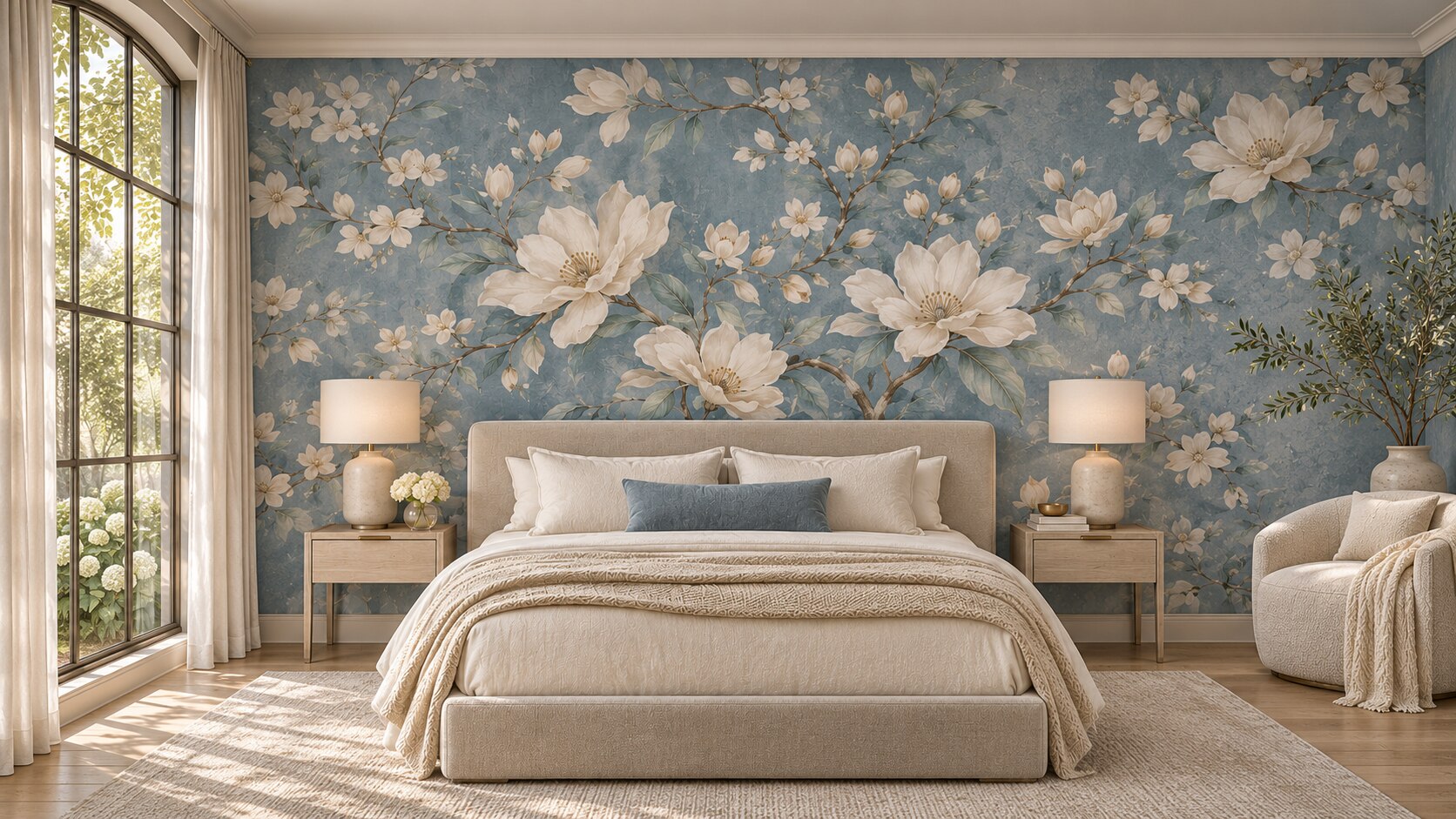
Make the bed wall the visual anchor, but place the main subject where the headboard will not hide it. A composition with open space behind the pillows and detail above eye level stays calmer and remains visible after wardrobes, bedside tables and artwork are added.
| Composition | Best use | Main risk |
|---|---|---|
| Small repeat | Walls with doors, wardrobes or changing furniture | A tiny, busy motif can feel restless at close range |
| Centered mural | A clear bedroom accent wall with a low or floating bed | The headboard can cover the focal subject |
| Tonal texture | All four walls or rooms with patterned flooring and bedding | Gloss, dark colour or strong texture can reveal seams and wall defects |
Choose sleep-friendly wallpaper colours such as muted blue, sage, warm grey, dusty rose or softened beige. Match the undertone to the floor: cool grey flooring suits blue-grey or green, while oak and walnut work with warm beige, clay or muted olive.
Use bedroom wallpaper ideas as a complete scheme rather than selecting the wallcovering alone. Compare a physical proof beside the bed fabric, wardrobe finish, flooring sample and lamps at night; daylight can make a low-contrast design appear much stronger after dark.
Plan wallpaper with curtains and blinds together. Avoid placing a high-contrast motif directly behind a patterned curtain, and check that the design does not terminate awkwardly beside a window recess. A professional layout should centre the most visible wall and account for pattern repeat, matching waste, corners and grazing light before panels are ordered.
Designing wallpaper for a living room
A living room wallpaper design must read clearly from the room’s main viewing distance, usually from the sofa or entry. Fine details can disappear across a large room, while an oversized motif can overwhelm a narrow wall.
Set the wallpaper pattern scale against the wall height, seating distance and amount of surrounding decoration; remember that a large repeat also increases matching waste at the ceiling and floor.
Furniture placement determines whether the design remains visible. Mark the sofa, television, shelving and artwork before approving a mural composition. A centred subject hidden behind a television or sofa looks accidental, while a small repeat is more forgiving when furniture or layouts change.
Place the living room feature wall where people naturally look from the entrance or seating area, not on a wall broken by several doors and windows.
Lighting can change the colour and expose defects. View the physical proof on the intended wall in daylight and evening lighting, because glossy, metallic and dark finishes show seam shadows and uneven plaster more readily than matte, lightly textured designs.
Good wallpaper and furniture coordination links one or two colours to the upholstery, rug or curtains without matching every surface. Before cutting, verify panel order, dimensions, scale and colour approval; a misplaced or reordered mural panel can disrupt the focal point and delay installation.
Adapting custom wallpaper for offices, hospitality and public-facing spaces
Specify the wallcovering as an assembly, not merely as “commercial grade.” Fire performance, smoke-development limits, flame spread, and required documents depend on the substrate, adhesive, installation method, and location. Check the jurisdiction’s adopted building code and the tested wallcovering-and-adhesive assembly; ASTM E84 reports surface-burning characteristics, but its result does not settle every code requirement.
Match the specification to the environment:
- Office wallpaper needs resistance to chair scuffs, hand contact, and routine cleaning, especially in corridors, reception areas, and lift lobbies.
- Restaurant and retail wallpaper needs a stated scrub and stain-resistance level, because grease, spills, shopping traffic, and frequent wiping expose weak finishes quickly.
- Healthcare and hospitality wallcovering needs documented cleanability, dimensional stability, and fire performance for the specific rooms, corridors, and exits. Food-service areas and healthcare zones can have stricter project requirements than ordinary offices.
Do not approve the design before confirming whether the product is paste-the-wall, paste-the-paper, pre-pasted, or heavy commercial vinyl. Activation, booking, open time, removal, and adhesive compatibility differ, so the manufacturer’s instructions control the installation.
For a mural, check the panel count, sequence, dimensions, scale, and colour proof before cutting. Order extra panels for installation damage and future repairs, then retain a labelled offcut because a later digital print batch may not match.
Dels Decor can help compare samples and specifications when selecting wallpaper for a Gurugram office or customer-facing venue.
Related product
 | Wallaper Wallaper Wallpaper Wholesale – Premium Collection by Dels Decor Dels Decor is a leading name in wallpaper wholesale, offering an exclusive range of premium... |
Frequently asked questions
What should a custom wallpaper brief include?
Include the wall area, finished height and width, viewing distance, lighting, furniture position and preferred mood. Provide artwork or request a designer’s concept, then approve a scaled proof.
How do you prepare a wall for custom wallpaper?
Measure the wall, check for unevenness and repair cracks, holes and loose paint. Clean and dry the surface before applying the recommended primer and wallpaper finish.
How should wallpaper be designed for a bedroom?
Choose a pattern scale and colour palette that suit the room’s viewing distance, lighting, furniture and intended mood. Check the crop and panel alignment before production.
How should custom wallpaper differ in offices and hospitality spaces?
Adapt the artwork to viewing distance, brand or interior scheme, traffic levels, lighting and maintenance needs. Confirm panel breaks around doors, windows, furniture and other public-facing features.