A sliding screen can fit an opening and still fail if its rollers do not match the tracks, its panels leave a meeting gap, or its frame blocks drainage and handles. You will be able to measure the opening, select the right panel and mesh arrangement, check compatibility, and identify when the frame needs modification or a different screen system.
Key takeaways
- Measure the clear opening at three points before ordering panels.
- Choose panel count based on the passage width you need open.
- Check roller alignment and track depth before fixing the frame.
- Clean tracks and inspect mesh before seasonal use.
How the Sliding Screen Travels and Seals
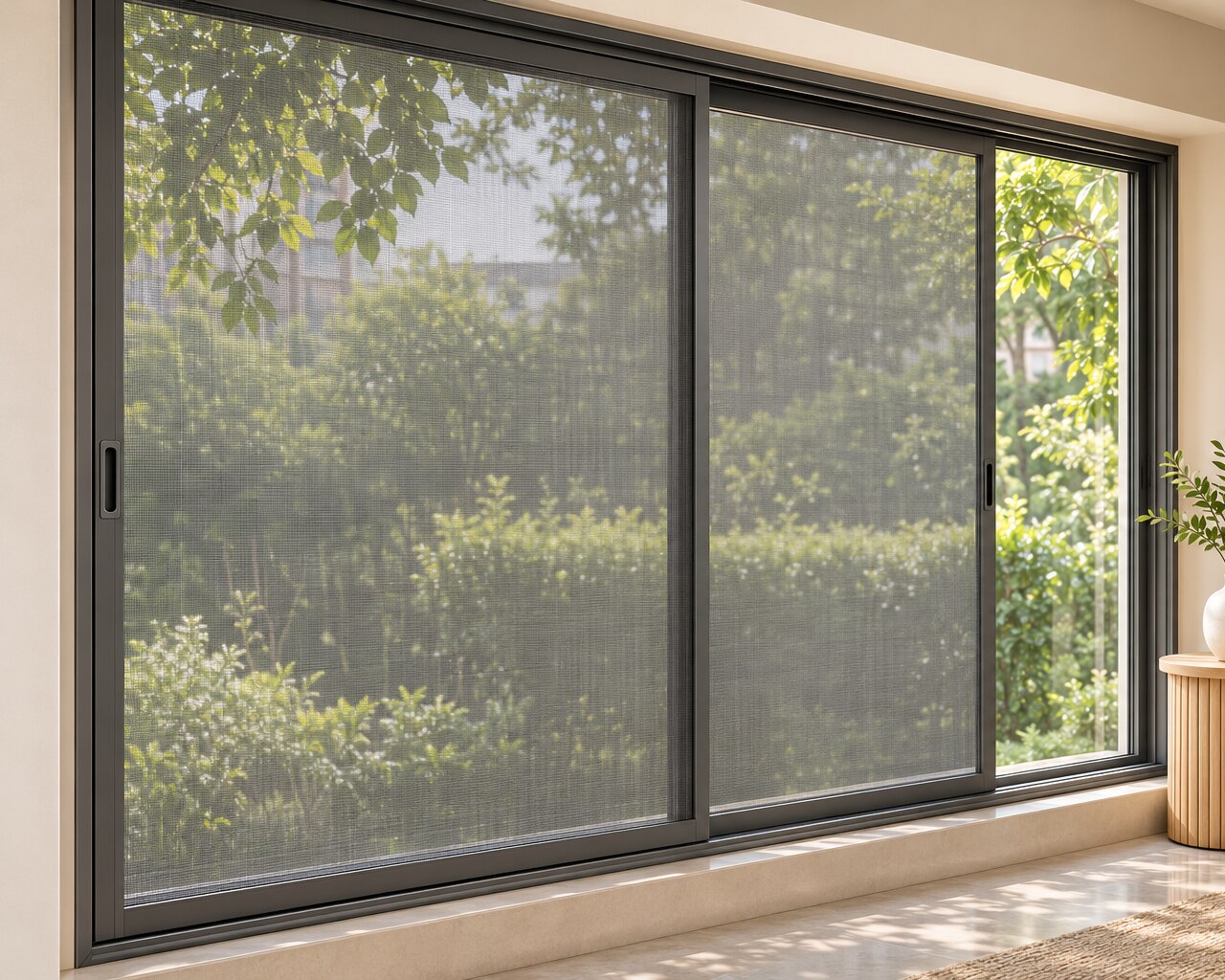
A sliding mosquito net mechanism carries one or more screen mesh panels sideways on sliding tracks instead of swinging them on hinges. Rollers sit in the lower guide, while the upper channel keeps each panel upright; the panel must remain captured as you open and close it without lifting, wobbling, or binding through travel smoothly.
At the meeting stile, overlapping panels must cross far enough for the brush or pile seal to touch its opposing surface continuously. A narrow overlap, compressed pile, or misaligned stile leaves a vertical entry route even when the panel dimensions look correct. The seal must stay engaged through the full travel at every position.
After installation, it should run without rubbing or derailment. Confirm rollers engage tracks and adjustment has not lifted the panel from lower guide; adjustment cannot fix an incompatible profile. Close it in daylight and inspect the perimeter for gaps. It is not a lock, guardrail, or child-safety device: keep primary door and balcony protection functional.
Measure the Opening and Test the Existing Frame
A sliding screen fits only when its frame and rollers match the existing track geometry, not merely when its advertised width and height match. Measure the finished opening width and height, then test how the panel enters, sits, and moves before ordering.
- Measure the width between finished jambs at the top, middle, and bottom; record the smallest measurement.
- Measure height from the lower track’s running surface to the upper track at the left, centre, and right; record the smallest measurement.
- Compare the two diagonals. A large difference indicates a racked opening that a generic size deduction will not correct.
- Measure track depth, upper and lower track profiles, and insertion clearance above the panel.
- Check that the tracks are straight, secure, unobstructed, and deep enough for the rollers to engage.
- Confirm that the existing rollers are adjustable, or specify replacement rollers that suit the track.
Use the system-specific deduction supplied for those sliding mosquito net measurements. A standard subtraction can leave insect-sized gaps, prevent insertion, or stop the panel from engaging both tracks. Keep continuous operating clearance; thick weatherstripping can increase drag, obstruct drainage, and still fail at the meeting overlap.
Do not cover weep holes or drainage paths. Water trapped in the sill accelerates corrosion and can cause staining or leakage. On exposed balconies, choose corrosion-resistant hardware and remove grit and salt from the track.
The mesh is not a lock, guardrail, or fall-prevention barrier. Keep the glazed door and protective barrier functional because impact can tear the mesh or push the panel out.
Choose Panel Count by the Opening You Need to Use
A two-panel mosquito net is practical when you need access through about half the opening at a time. One panel slides behind the other into the side parking zone, leaving the front panel’s width as the usable opening; confirm that the parked panels do not block a handle, curtain, or drainage path.
A three-panel sliding screen suits a wider balcony door where a single half-width passage is inconvenient. Depending on the track layout, one panel can remain fixed while two slide and overlap at one side, or the panels can divide movement between both sides. Specify the exact parking arrangement rather than accepting “three-panel” as sufficient.
| Option | Usable opening | Where panels park |
|---|---|---|
| Two-panel | About one panel width | Both panels overlap in one side bay, or one remains fixed while the other parks behind it |
| Three-panel | About one to two panel widths | Panels stack in one side bay or divide between two side bays, according to the track |
| Multi-panel balcony door screen | A wider opening with smaller individual leaves | Panels stack in one or both parking zones; every added panel needs track space and overlap |
At the meeting stile, require enough overlap and an intact brush or pile seal. A narrow vertical gap can admit mosquitoes even when the panels look correctly sized. Keep the primary glazed door, lock, and guardrail functional: the screen is not a fall-prevention or child-safety barrier.
Do not cover sill weep holes with parked panels or new tracks.
Compare Frames, Mesh Materials, and Purchase Specifications
For most windows, an aluminium frame with standard fibreglass mesh gives the best balance of rigidity, airflow, visibility, insect resistance, and straightforward repair. Choose heavier pet-resistant mesh only when claws or impact are a real concern; it needs a stronger spline, stiffer panel, and correctly sized rollers.
| Option | Strengths | Limitations and best use |
|---|---|---|
| Aluminium frame with fibreglass mesh | Rigid, light, corrosion-resistant when properly finished, easy to re-mesh | Fibreglass tears under claws and abrasion; best general choice for windows and ordinary balcony doors |
| uPVC sliding screen | Smooth appearance, good weather resistance, and low routine maintenance | Can be less rigid in large panels; confirm roller support and replacement mesh availability |
| Aluminium or stainless-steel mesh | Better resistance to claws, sharp objects, and impact | Heavier, harder to tension cleanly, and metal can crease or corrode in unsuitable conditions |
| Magnetic and pleated mesh | Minimal visual bulk; pleated systems fold aside and suit wide openings | Magnetic systems do not provide a rigid sliding panel; pleated mesh needs careful cleaning and can be harder to repair |
Ask the supplier to state these purchase specifications:
- Frame alloy or uPVC profile, finish, and panel weight.
- Mesh pattern and material; standard insect mesh is commonly about 18 by 16, while finer mesh helps exclude smaller gnats but reduces airflow and visibility.
- Spline size, roller material, track compatibility, and replacement-mesh availability.
- For humid or coastal exposure, corrosion-resistant rollers, fasteners, and track components.
A screen is not a lock, guardrail, or fall-prevention barrier. Keep the glazed door and balcony protection functional.
Install, Adjust, and Maintain the Screen Without Creating New Problems
Smooth operation depends on a level frame, an unobstructed lower track, and rollers adjusted to keep the panel captured without binding. A crooked opening cannot be fixed by tightening the rollers; excessive mosquito net roller adjustment can lift the panel out of the lower guide.
Prepare the opening before fitting the panel:
- Remove grit, loose paint, bent track sections, and raised threshold spots.
- Complete lower track cleaning before inserting the rollers.
- Keep balcony door drainage holes and weep paths open; blocking them traps rainwater in the sill.
- Check that the panel overlaps the meeting stile without rubbing or leaving a continuous insect-sized gap.
- Test the panel at several positions, including fully open and fully closed.
Modify the frame or change the screen when the existing geometry makes those checks impossible.
| Option | Sign | Correct response |
|---|---|---|
| Straight, compatible track | Rollers stay seated and the panel needs little effort | Adjust roller height in small increments |
| Bent or incompatible track profile | The panel derails despite correct roller adjustment | Repair or replace the track, or choose another screen system |
| Heavy pet-resistant mesh | The panel sags, drags, or strains its spline | Use a rigid frame, stronger spline, and correctly rated rollers |
| No usable track depth | A panel cannot remain captured | Choose a pleated, magnetic, or purpose-built frame system |
Dels Decor can help compare the opening against a workable screen system rather than treating roller adjustment as a cure-all. Do not rely on any screen as a balcony guard, lock, or fall-prevention barrier. For tears, match the repair to the mesh; pet-resistant mesh repair needs heavier replacement material and secure spline seating.
Frequently asked questions
How does a sliding mosquito net travel and seal?
Rollers carry each panel in the lower guide, while the upper channel keeps it upright. The panel should stay captured throughout travel and meet the side or overlapping seal without binding.
How should you measure an opening for a sliding mosquito net?
Measure width and height at the top, middle, and bottom of the clear opening. Use the smallest measurement, then check that the existing frame has enough depth for the upper channel, lower guide, and rollers.
How many sliding screen panels does an opening need?
Choose the panel count according to the passage you need to use. More panels can reduce the size of each moving section, while fewer panels may leave a wider clear opening per movement.
What should you compare when buying a sliding mosquito screen?
Compare frame material, mesh type, roller quality, track dimensions, panel overlap, handle design, and the stated opening size. Confirm the supplied dimensions match your measured frame.
How do you maintain and adjust a sliding mosquito net?
Remove dust from both tracks, check that rollers turn freely, and adjust roller height if the panel scrapes or wobbles. Repair torn mesh and keep the frame square to prevent recurring binding.