A window awning works only when its projection, pitch, fabric, mounting, and operating limits match the window’s orientation and the site’s weather. By the end, you will be able to measure the opening, compare awning designs and fabrics, specify weather-resistance details, and decide whether an awning, sun-control film, or both fit your space.
Key takeaways
- Use projection and sun angle to calculate the shaded glass area.
- Choose outdoor fabric with UV, water, mildew, and fade resistance.
- Set a positive pitch so rain drains instead of pooling.
- Use wind-safe operation and secure brackets fixed to structural material.
What a Window Awning Is and How the Main Designs Differ
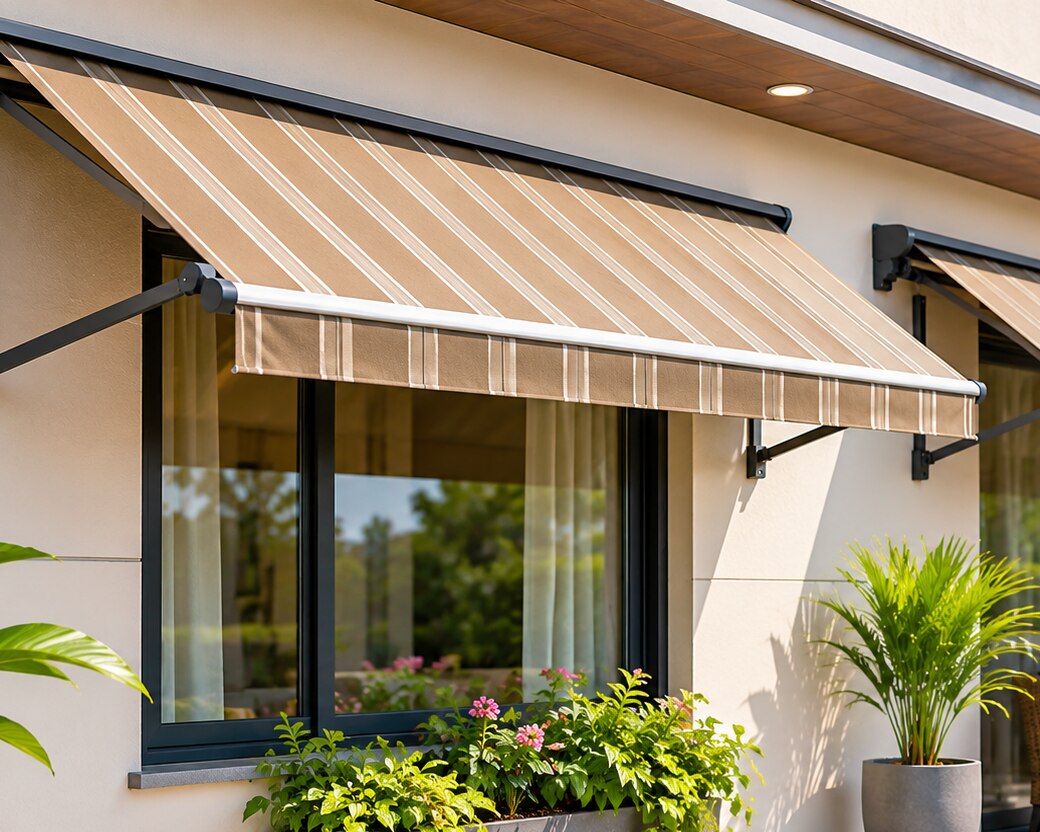
A window awning is a projecting cover that shades glass and nearby outdoor space. Its awning canopy may be fabric, acrylic-coated textile, or metal; the awning frame supports it, brackets transfer the load into the wall, and projection from wall determines how far shade extends. Positive pitch lets rain drain instead of pooling.
| Design | Best fit | Main difference |
|---|---|---|
| Retracable awning | Windows with changing sun and weather | Extend for shade, retract before strong wind or heavy rain |
| Fixed awning | Constantly shaded windows or entrances | Permanent cover, with no seasonal adjustment |
| Freestanding awning | Terraces or seating where the wall cannot carry the load | Independent posts need a properly anchored base |
| Drop-arm awning | Windows needing adjustable side shade | Pivoting arms lower the canopy and improve side coverage, but remain visibly exposed |
| Cassette awning | Clean façades and lower maintenance | The closed cassette stores and protects the rolled canopy, arms, and fabric |
| Motorised awning | Wide, high, or frequently used openings | A switch or sensor controls deployment, but power, controls, and wind automation need maintenance |
A fixed awning provides constant cover but can reduce winter sunlight. A retractable awning suits changing conditions because you choose when to shade or expose the glass. A drop-arm awning gives stronger lateral protection than a flat projection; a cassette awning looks neater and shields stored fabric.
No awning encloses a seating area: side gaps and wind-driven rain remain, while screens add protection and wind load.
How to Measure an Awning for Sun Angle and Window Coverage
An awning that matches the window width can still leave the glass exposed. How to measure for a window awning is a sun-path exercise: record the opening, the shade needed at each edge, and the obstacles around the mounting area.
1. Measure the window opening width and height, then note the desired side coverage in millimetres on the left and right. Include the frame, trim, handles, shutters, and any section that must remain accessible.
2. Record the available projection depth from the wall. Choose awning projection from the sun’s angle, not window width alone: a horizontal awning suits high summer sun on a south-facing window in the Northern Hemisphere, while low-angle morning sun and low-angle afternoon sun from east or west can pass beneath it.
3. Increase projection or add side panels, vertical screens, or exterior shutters where east- or west-facing glass receives persistent low-angle sunlight. A wide but shallow canopy can shade less glass than a narrower, deeper one.
4. Measure headroom above the opening and mark the bracket position. Check that brackets can sit on sound masonry or structural framing, clear of doors, balconies, neighbouring windows, pipes, shutters, vents, and wall edges.
5. Set the awning pitch with a positive drainage slope so rain runs away instead of pooling. Follow the manufacturer’s pitch range; a nearly level canopy can stretch fabric, increase frame loads, and leak.
6. For a retractable model, trace the full path of the canopy, arms, front bar, and cassette. Check extension, folding clearance, door swings, balcony edges, and overhead obstructions before fixing brackets.
Which Awning Fabrics and Weather Ratings Matter Outdoors
Colour is only the surface choice. Compare awning fabric by UV stability, rain behaviour, seam construction, weight, and heat buildup before approving a sample.
| Fabric | UV stability and colour fading | Breathability and heat | Water, seams, weight, cleaning |
|---|---|---|---|
| Acrylic-coated polyester | Moderate UV stability; colour fading depends on coating and dye | Limited breathability; can feel hot beneath direct sun | Water-resistant, not fully waterproof; coated seams need care; medium weight and easy to wipe |
| Solution-dyed acrylic | High UV stability and strongest resistance to colour fading | Breathes better, reducing trapped heat and condensation | Sheds light rain; stitched seams remain vulnerable; light to medium weight and washable |
| PVC-coated fabric | Good UV protection, but dark colours absorb heat | Low breathability; greater heat buildup underneath | Strong waterproofing when welded correctly; heavier, highly cleanable, and robust in wet conditions |
| Laminated fabric | UV stability varies by film and outer cloth; inspect the warranty | Low to moderate breathability; laminate can increase heat | Waterproofing depends on bonded layers and seams; heavier, cleanable, but delamination can cause failure |
Understand water-resistant versus waterproof: wind-driven rain can enter beneath the canopy or through seams even when the fabric sheds light rain. A positive slope and clear drainage path prevent pooling, stretching, leakage, and excess frame loads.
Before ordering, request these specific documents and details:
- The installed model’s awning wind rating and documented suitability for monsoon gusts in Gurugram or New Delhi
- A corrosion-resistant frame, fasteners with stated corrosion resistance, and sealed wall penetrations
- Drainage provisions, seam or weld details, and cleaning instructions
A generic “weatherproof” claim proves little without those details.
How to Mount and Operate an Awning Safely in Rain and Wind
A failed awning usually fails at the wall, not in the fabric. Safe awning installation must carry uplift, pull-out, and leverage into sound masonry or structural framing.
1. Fix wall anchors and brackets into brick, concrete, steel, or verified timber framing. Do not rely on thin cladding, trim, render, or surface finishes. A large projection creates greater leverage at the attachment line, so confirm the substrate and fastener specification before drilling.
2. Set a positive slope suited to the awning design and manufacturer’s instructions. Good awning drainage sends water away from the wall; a nearly level cover can pool, stretch fabric, increase frame loads, and leak.
3. Protect every wall penetration with correctly detailed flashing and seals compatible with the wall finish and hardware. A bead of caulk over an exposed fastener hole is not a drainage system, and failed seals can send water behind cladding.
4. Treat wind safety as part of retractable awning operation. Many awnings handle light rain, but retract them before gusty wind, thunderstorms, heavy rainfall, or monsoon gusts unless the manufacturer specifies that exact use and provides a matching wind rating.
5. Use side curtains or screens when you need better rain and splash protection, but account for their added wind loading. An awning alone is not an outdoor enclosure; side gaps, wind-driven rain, splashback, and runoff at the building edge remain open.
When an Awning Is Better Than Sun-Control Film—and When to Combine Them
Choose an exterior awning when reducing solar heat gain is the priority; choose interior sun-control film when the window cannot accept an external projection. An awning provides exterior solar shading by blocking direct radiation before it reaches the glazing, while film acts after sunlight reaches the glass by reducing heat transmission and glare.
For solar heat gain, the U.S. Department of Energy reports maximum potential reductions of up to 65% for south-facing windows and 77% for west-facing windows. These figures are not guaranteed energy savings: orientation, projection, side coverage, glazing, climate, and deployment habits all change the result.
| Option | Acts where | Best fit | Main limitation |
|---|---|---|---|
| Exterior awning | Before sunlight reaches glazing | Strongest heat control; useful for sunny south or west windows | Needs wall space, projection clearance, and seasonal operation |
| Interior sun-control film | At or after sunlight reaches glass | Interior glare reduction where heritage appearance, security, window access, or projection rules prevent an awning | Less effective than exterior shading because heat enters the room |
| Both together | Outside and at the glazing | High glare and heat exposure, especially with difficult glazing or inconsistent awning use | Higher installation cost and more components to maintain |
Retract a seasonal awning during winter when passive solar warmth helps, then deploy it before intense summer sun; east- and west-facing windows may need side screens or deeper coverage. Film does not stop all UV exposure or prevent fading of flooring, paint, furniture, or curtains because glass and unshaded areas still transmit light.
Dels Decor can compare a customised awning with existing window treatments and interior finishes, including flooring, so the selected combination matches actual orientation, glazing, access, and room-use needs.
Frequently asked questions
What is a window awning?
A window awning is a projecting cover that shades glass and nearby outdoor space. Its canopy can use fabric, acrylic-coated textile, or metal, while brackets transfer the load into the wall.
How do you measure a window awning for sun protection?
Measure the window width, include the desired side overhang, and choose projection based on the sun angle and the glass area you need to shade. A positive pitch improves rain drainage.
Which awning fabric is suitable for outdoor use?
Choose fabric rated for outdoor exposure with resistance to ultraviolet light, water, mildew, fading, and tearing. Check the manufacturer’s cleaning instructions and wind limits.
How should you operate an awning in rain and wind?
Install brackets in structural material, maintain a positive pitch, and retract the awning within its stated wind limit. Do not leave a fabric awning extended during severe weather.
Is a window awning better than sun-control film?
An awning blocks sunlight before it reaches the glass and also shades nearby outdoor space. Sun-control film works at the glass and remains in place during changing weather; combining both can improve control when exterior shading alone is insufficient.
Keywords