The right accent wall depends on more than a striking print: its position, sightline, light, proportions, and relationship with furniture determine whether the result feels designed or distracting. By the end, you will be able to choose a suitable wall, compare designer styles, coordinate finishes, and prepare an accurate wallpaper and installation brief.
Key takeaways
- Choose a wall behind a bed, sofa, table, fireplace, or desk.
- Use large patterns in spacious rooms and smaller motifs in compact rooms.
- Test wallpaper samples beside flooring, paint, furniture, and daylight.
- Measure each wall, account for pattern repeat, and add installation waste.
Choose the Wall Before You Choose the Wallpaper
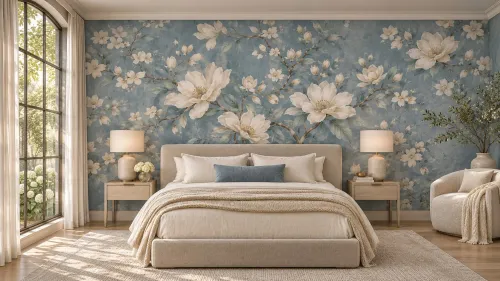
Choose the wall with a clear focal role or architectural boundary: behind a bed, sofa, dining table, fireplace, or desk. This is the strongest answer to which wall to wallpaper because the furniture gives the pattern a visual anchor rather than leaving it floating.
One wall is enough when the room already has strong furniture, flooring, lighting, or artwork. Cover more walls only when the room is visually quiet enough to support additional pattern.
Useful accent wall ideas begin with what you see first from the entrance and from the main seating position, then consider natural light, furniture placement, doors, windows, and the wall’s proportions.
| Wall choice | Best use | Main risk |
|---|---|---|
| Long, uninterrupted wall | Wallpaper focal wall or mural | Pattern may need more rolls because of its length |
| Wall behind a bed or sofa | Clear focal point framed by furniture | Side-lighting can reveal bumps and patched joints |
| Wall with several doors or windows | Light texture or small repeat | A mural can look randomly cut around openings |
| Narrow wall | Wallpaper for small rooms with a controlled oversized design | Large horizontal effects can make the room feel tighter |
A long, uninterrupted wall usually frames a repeat better than a broken wall. Side-lighting from a window or wall washer exposes ridges and patched joints, so smooth or thin wallpaper will not disguise poor preparation. Vertical designs can make a low ceiling feel taller; broad horizontal effects emphasise width.
Oversized patterns can make a small wall feel intimate but overwhelm a narrow room.
Match the Pattern Scale to the Room’s Character
Choose the wallpaper style by the room’s mood, furniture, and visual effect, not by pattern alone. These designer wallpaper ideas match common modern settings:
| Style | Visual effect | Best fit |
|---|---|---|
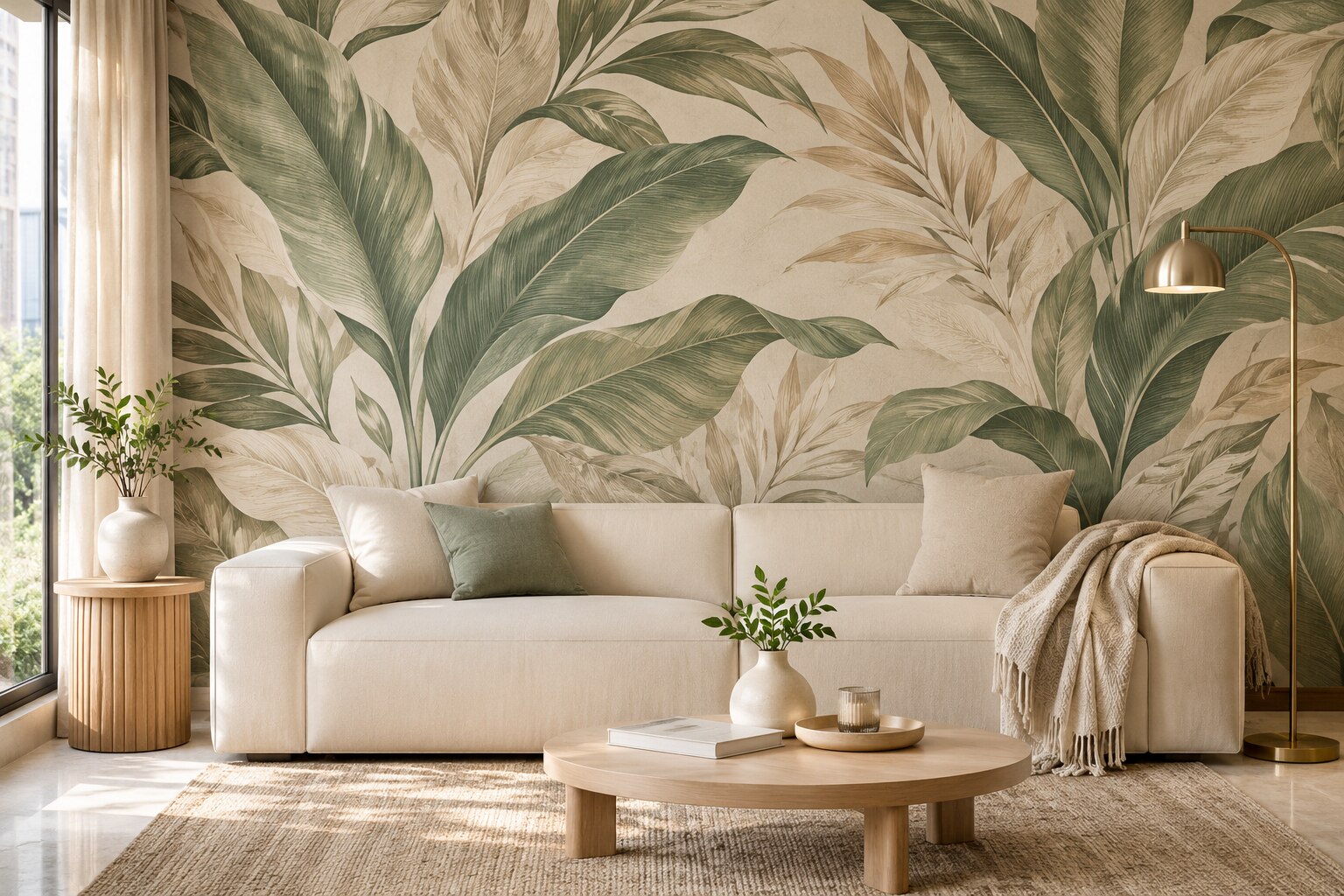
| Large-scale botanical wallpaper | Dramatic, immersive focal point | Living rooms or bedrooms |
| Geometric wallpaper | Structured, orderly contrast | Home offices or contemporary dining areas |
| Mural wallpaper accent wall | One continuous scene | A feature wall with few interruptions |
| Textured neutral | Calm depth without visual noise | Bedrooms, entryways, or rooms with strong furniture |
| Metallic detail | Controlled evening glamour | Entertaining spaces with warm lighting |
| Abstract art | Expressive, gallery-like energy | Modern rooms with simple furnishings |
| Monochrome print | Contrast without many colours | Rooms already containing several finishes |
| Restrained traditional motif | Warmth without formality | Dining rooms, bedrooms, or transitional interiors |
Choose a bold mural when the wall has few doors, windows, or switches. Choose subtle texture for busy furniture, a geometric repeat for disciplined structure, a dark colour for depth behind pale furnishings, and a light neutral when daylight is limited.
A faux-material finish suits a modern industrial or natural scheme, but avoid a busy design behind a television if it competes with the screen.
Straight-match patterns align each drop at the same height. Drop-match designs alternate the starting height, so they use more paper; larger repeats also create more offcuts. Random-match patterns need little alignment and usually waste less.
Use a cleanable finish in a children’s room only when its manufacturer rating supports it; washability is not automatic. Keep entryway patterns legible from close range, where oversized detail can become visual clutter.
Build a Colour and Material Palette Around Existing Finishes
1. Build wallpaper colour coordination around the finishes that cost the most to replace: wooden flooring, carpet, cabinetry, stone, sofa fabric, and window treatments. With wallpaper with wooden flooring or wallpaper with curtains, pull one secondary colour from the material instead of matching its dominant shade exactly.
2. Treat wallpaper lighting colour as part of the palette. Warm beige, terracotta, oak, and brass suit warm-white lamps at 2700K to 3000K; test blue, grey, and green samples beneath the room’s actual lamps before ordering.
Use dark wallpaper on a naturally bright wall or behind pale furniture for depth, while limited daylight calls for a light neutral or textured design.
3. Match metallic details to existing handles, taps, curtain poles, or light fittings. Charcoal and black cabinetry make prints appear stronger; walnut deepens warm patterns; cream softens contrast; painted cabinetry makes the wallpaper’s undertone more noticeable. Avoid combining several competing metal finishes.
4. Apply the palette to the room’s purpose: choose soft neutrals behind a bed, balanced botanicals behind a living-room sofa, and restrained motifs in dining spaces. Low-contrast textures suit offices, while children’s rooms benefit from cheerful designs that are playful without becoming visually busy.
Check the sample beside the flooring, curtains, upholstery, paint, and cabinetry before deciding.
Test the Sample and Calculate the Order Correctly
1. Test a full sample in the actual room before buying or booking installation. View it in daylight, under warm artificial light, and beside the flooring, curtains, upholstery, cabinetry, and existing paint. This wallpaper sample testing exposes colour shifts that a catalogue image hides.
2. Ask the supplier to state the roll width, usable length, material, surface finish, wallpaper pattern repeat, pattern-match type, application method, cleanability rating, and batch or dye-lot information. Confirm whether it is paste-the-wall non-woven or paper-backed wallpaper requiring paste on the back and booking; never infer the method from “wallpaper.”
3. Use wallpaper roll calculation by measuring each wall in drops, not wall area alone. Allow for matching and trimming before subtracting doors or windows, then use the manufacturer’s repeat information: straight-match and drop-match designs create more waste than random-match patterns. Order every roll together and confirm one batch when batch information is provided.
4. Complete wallpaper installation preparation on a clean, dry, smooth, sound wall. Sand gloss paint, fill repairs, remove dust or chalk, and apply compatible primer or sizing. Plan edge-to-edge seams away from corners where possible, and dry-plan murals around sockets, switches, doors, and windows.
Check cleaning instructions, moisture limitations, removal claims, and any UL GREENGUARD Gold certification separately from labels such as “natural” or “PVC-free.”
Turn the Design Into a Clear Installation Brief
A one-page wallpaper installation brief turns a design preference into instructions the installer can follow. It prevents a centred pattern from landing behind a door or a mural’s key detail from disappearing behind a switch.
1. Mark the selected wall on a room plan and attach a photograph taken from the entrance. Show furniture locations, windows, doors, outlets, the preferred visual centre, and the pattern direction.
2. Place the approved sample beside flooring, curtain, upholstery, and paint samples. Attach the supplier’s roll width, usable length, repeat, match type, application method, cleaning instructions, and batch number. This record supports wallpaper and flooring coordination during a wallpaper supplier consultation.
3. Before paste is applied, ask the installer to inspect the substrate, correct gloss, dust, cracks, patched joints, or uneven areas, and check defects revealed by side-lighting. Require a dry plan of the drops around openings, plus agreement on seam positions and the visual centre.
4. Record handover requirements for cleaning, humidity, ventilation, and edge finishing. Moisture-resistant wallpaper is not waterproof: bathrooms still need ventilation and sealed edges because condensation can loosen adhesive and encourage mould.
For local comparison, Dels Decor can help you discuss wallpaper beside flooring and window-treatment choices; request specific product data rather than accepting a collection label. Base the final accent wall installation on the verified sample, sightline, lighting, batch, and realistic roll calculation—not a catalogue image alone.
Related product
 | Wallaper Wallaper Wallpaper Wholesale – Premium Collection by Dels Decor Dels Decor is a leading name in wallpaper wholesale, offering an exclusive range of premium... |
Frequently asked questions
Which wall should you choose for wallpaper?
Choose a wall with a clear focal role or architectural boundary, such as the wall behind a bed, sofa, dining table, fireplace, or desk.
How do you match wallpaper pattern scale to a room?
Use larger patterns where the room has more visual space and smaller motifs where furniture, openings, or compact dimensions could overwhelm the design.
What should you check before ordering wallpaper?
Test a sample beside existing finishes in daylight and calculate the number of rolls using wall dimensions, pattern repeat, roll coverage, and installation waste.
What should an installation brief include?
State the wall locations, wallpaper design and batch details, pattern direction, surface-preparation requirements, seam expectations, and areas that need careful trimming.